Travel dog food container: compare bags, kits, jugs and bins
Compare travel dog food containers by format, capacity, closure, size, included parts and care instructions, with maker facts verified October 18, 2026.
When an article contains affiliate links, we may earn a small commission at no extra cost to you. It never changes which products we recommend, and plain links to manufacturers earn us nothing.
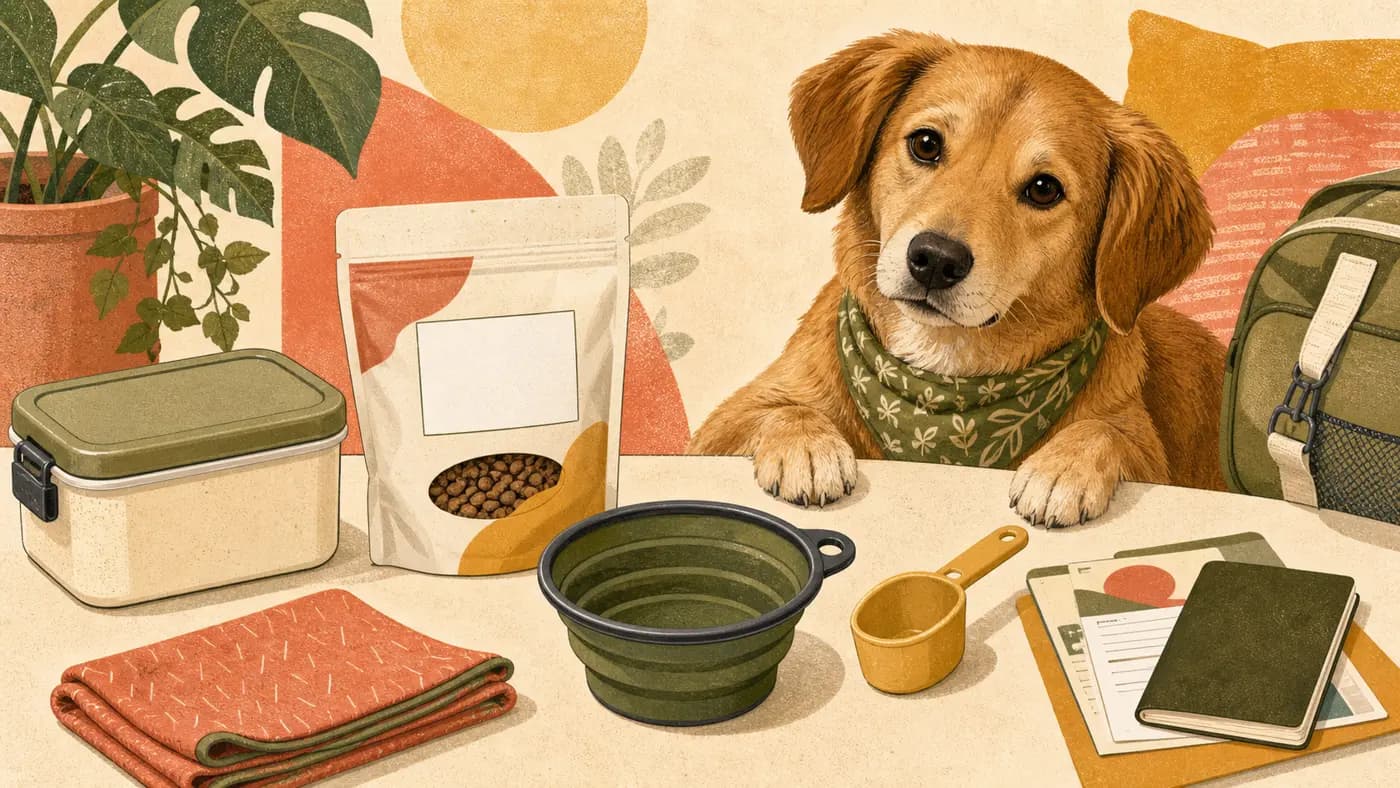
Choose a travel dog food container by load and format. A soft roll-top bag packs differently from a rigid kit with bowls. A compact jug combines a screw-on lid, handles and a cup, while a large bin or bucket suits destination staging (Wilderdog; Petmate Travel-Trainer; Petmate Junior; Petmate Outback). Compare maker-listed capacity, closure, size, weight, included parts and care instructions. The maker pages do not establish a universal freshness or safety winner. Furry Guardian did not test these products. Product facts were verified on October 18, 2026.
Quick pick: choose the load size first, then compare the format, closure, included parts, dimensions, empty weight and care instructions published for that product.
What is the best travel container for dog food?
No manufacturer page in this comparison establishes one container as best for every trip. The practical choice is between four formats: a soft bag for a roll-top form, a rigid kit when included bowls matter, a compact jug with a cup and handles, or a large bucket or bin for destination staging (Wilderdog; Petmate Travel-Trainer; Petmate Junior; Petmate Outback).
Use this order:
- Compare the maker-listed capacity.
- Check the published dimensions or empty weight when the page provides them.
- Compare the closure and included parts.
- Read the maker's care instructions.
- Open the product page for current pricing.
Manufacturer pages show several distinct forms. Petmate lists portable kits, compact jugs, treat boxes, buckets, large bins and spin-on lids in its pet food storage collection. RuffLand lists rigid boxes on the Chow Box page.
The listed parts also differ. The Travel-Trainer includes two 3-cup bowls and a carry handle (Petmate). The Junior has molded handles, a screw-on lid and a pop-off cup (Petmate). Little Vittles has a removable silicone seal (Petmate). The Chow Box includes its storage container and a measuring scoop, while the Standard version also has a bowl rest (RuffLand). The GAMMA Seal Lids page lists a lid for standard 3.5-gallon through 7-gallon buckets and does not include a bucket body (Petmate).
There is no overall winner here. The table compares formats on the same fields and leaves price to each maker's current page.
Which travel dog food container format fits your trip?
Compare the published facts rather than the order in which products appear. The capacities, dimensions and included parts below come from manufacturer pages verified on October 18, 2026 (Petmate collection; Wilderdog; RuffLand).
| Product | Format | Maker-listed capacity | Closure and included parts | Empty size or weight | Current pricing |
|---|---|---|---|---|---|
| Petmate Little Vittles | Rigid treat or dry-food box | Up to about 4 lb (Petmate) | Gamma Seal-style lid and removable silicone seal (Petmate) | 8.13 × 6.59 × 8.42 in and 1.53 lb (Petmate) | See current price |
| Petmate Vittles Vault Junior | Rigid compact jug | About 4–6 lb (Petmate) | Screw-on lid, molded handles and pop-off cup (Petmate) | 5.5 × 5.5 × 12 in and 0.99 lb (Petmate) | See current price |
| Petmate Vittles Vault Travel-Trainer | Rigid kit with bowls | About 6-cup chamber and two 3-cup bowls (Petmate) | Twist-off top, carry handle and two bowls (Petmate) | 7.5 × 5.5 × 5.5 in and 1.08 lb (Petmate) | See current price |
| RuffLand Chow Box Mini and Standard | Rigid travel box | Mini 15 lb; Standard 30 lb (RuffLand) | Moisture-resistant, spill-resistant airtight lid; measuring scoop included; Standard has a bowl rest (RuffLand) | Mini 20.5 × 12 × 14.5 in; Standard 24 × 14 × 17 in (RuffLand) | See current price |
| Wilderdog Doggie Bag | Soft roll-top bag | About 5 lb or 20 cups (Wilderdog) | Roll-down clip and stainless steel cup of about 1.25 cups or 10 oz. Wilderdog advises placing especially greasy kibble, or kibble kept in the Doggie Bag for an extended period, in a Stasher Stand-Up Mega Bag inside the Doggie Bag (Wilderdog) | About 12 × 18 in laid flat and 7.6 oz (Wilderdog) | See current price |
The table is a dated snapshot of product facts, not a test result or a complete market survey. Terms such as "airtight" describe maker wording. Furry Guardian did not test these products.
Should you pack a small trip load or a large destination load?
Use the capacity and format to narrow the choice. This is a size decision, not a freshness or safety verdict.
- For a small trip load, compare the Travel-Trainer's 6-cup chamber, the Junior's 4 to 6 lb jug, Little Vittles at up to about 4 lb, or the Doggie Bag at about 5 lb or 20 cups (Petmate Travel-Trainer; Petmate Junior; Petmate Little Vittles; Wilderdog).
- For a large destination or staging load, compare the 15 lb or 30 lb Chow Box, the Outback Bucket bands of 10 to 15 lb and 20 to 25 lb, or the Outback Container versions holding up to 30 lb or 50 lb (RuffLand; Petmate Outback Bucket; Petmate Outback Container).
How to store dog food for travel?
The manufacturer pages support a comparison of capacity, closure, included parts and care instructions. They do not provide one storage rule for every product.
- The Travel-Trainer lists a twist-off top, carry handle and two bowls with a chamber capacity of about 6 cups (Petmate).
- Little Vittles lists a Gamma Seal-style lid, removable silicone seal and capacity of up to about 4 lb (Petmate).
- The Chow Box lists a moisture-resistant, spill-resistant airtight lid and an included measuring scoop (RuffLand).
- The Doggie Bag lists a roll-down clip, capacity of about 5 lb or 20 cups and an included stainless steel cup. Wilderdog advises placing especially greasy kibble, or kibble kept in the Doggie Bag for an extended period, in a Stasher Stand-Up Mega Bag inside the Doggie Bag (Wilderdog).
- The Travel-Trainer page says to hand-wash its chamber with warm soapy water and lists its bowls as dishwasher safe (Petmate).
If the food shares space with other dog gear, compare that plan with our pet carrier backpack guide or dog carrier for hiking guide.
Is it better to keep dog food in the bag or a container?
These manufacturer pages do not support a general safety verdict between an original bag and a separate container. This dry-food comparison therefore limits the choice to the product facts that the makers publish.
| Comparison field | Facts available on the cited pages |
|---|---|
| Capacity | About 6 cups for the Travel-Trainer, about 4 to 6 lb for the Junior, up to about 4 lb for Little Vittles, 15 or 30 lb for the Chow Box and larger bands for Outback products (Petmate; RuffLand) |
| Closure | Twist-off, screw-on, Gamma Seal-style, roll-down clip and sealing-lid formats appear in the maker descriptions (Petmate; Wilderdog; RuffLand) |
| Included parts | Depending on the product, the page lists bowls, a pop-off cup, a stainless steel cup or a measuring scoop (Petmate; Petmate; Wilderdog; RuffLand) |
This dry-food comparison does not evaluate wet-food storage.
What is the best dog food carrier for travel?
For food, the cited pages list a soft roll-top bag, rigid boxes, a compact jug and a chamber-and-bowls kit. A dog carrier is a separate product category.
The Chow Box page lists rigid Mini and Standard boxes with capacities of 15 lb and 30 lb (RuffLand). Petmate's Junior is a compact jug with a screw-on lid, molded handles and a pop-off cup. The Travel-Trainer combines a chamber with two bowls (Junior; Travel-Trainer).
If you meant equipment that carries the dog, use the pet carrier backpack guide. Keeping the jobs separate keeps the search focused.
When does a large dog food container make sense?
Petmate publishes larger capacity bands for its Outback Bucket and Outback Container.
Petmate lists Outback Bucket capacity bands of 10–15 lb and 20–25 lb (Petmate). Its Outback Container page lists versions holding up to 30 lb and up to 50 lb (Petmate). GAMMA Seal lids fit standard 3.5–7 gallon buckets, but the page sells the lid rather than the bucket body (Petmate).
If you consider the Outback Container for home or destination staging, Petmate says it is for indoor or covered outdoor use and recommends climate-controlled storage (Petmate). Its page also says that capacity depends on kibble shape and density.
What do I use for long car rides with dogs?
The maker pages describe several products as travel formats and list their included parts. This article does not add a travel-safety recommendation.
The product pages list these included parts:
- A chamber with two 3-cup bowls in the Travel-Trainer (Petmate).
- A rigid Chow Box with a measuring scoop (RuffLand).
This article does not make vehicle-safety claims about food containers. For a separate look at restraint evidence, read the dog seat belt guide.
How do you clean a travel dog food container?
Use the instructions for the exact chamber, bowl, lid and seal you own. The maker pages do not give one universal cleaning method.
- The Travel-Trainer page says to hand-wash the clear chamber with warm soapy water and dry it. It lists the bowls as dishwasher safe (Petmate).
- The Little Vittles page says to remove the silicone seal, hand-wash it with warm soapy water, rinse it and dry it (Petmate).
- The Junior page says, "We recommend thoroughly washing and drying your Vittles Vault Container regularly" (Petmate).
- The Outback Container page uses the same "regularly" instruction and does not provide a numerical schedule (Petmate).
Follow the maker's wording. This guide does not add a cleaning frequency or food-handling rule.
Travel dog food container checklist
Use this checklist to compare only the fields published on the current product pages.
- Record the maker-listed capacity.
- Record the published dimensions and empty weight when available.
- Compare the listed closure.
- Check which bowls, cups, scoops, lids or seals the product includes.
- Read the maker's care instructions for the exact product.
- For the Doggie Bag, note Wilderdog's advice to place especially greasy kibble, or kibble kept in the bag for an extended period, in a Stasher Stand-Up Mega Bag inside the Doggie Bag (Wilderdog).
- For an Outback Container considered for home or destination staging, note Petmate's indoor or covered outdoor use statement and its recommendation for climate-controlled storage (Petmate).
- Open the maker page for current pricing.
Food gear is one part of a wider move. Browse the travel hub for route planning. If you are also reviewing coverage for an international move, Compare expat pet insurance.
- Petmate, Pet Food Storage Collection: https://www.petmate.com/collections/pet-food-storage
- Petmate, Vittles Vault Travel-Trainer Portable Food Storage Container: https://www.petmate.com/products/vittles-vault-travel-trainer-portable-food-storage-container
- Petmate, Vittles Vault Junior: https://www.petmate.com/products/vittles-vault-junior
- Petmate, Little Vittles Storage Container: https://www.petmate.com/products/vittles-vault-little-vittles-storage-container
- Petmate, Vittles Vault Outback Pet Food Storage Bucket: https://www.petmate.com/products/vittles-vault-outback-pet-food-storage-bucket
- Petmate, Vittles Vault Outback Food Storage Container: https://www.petmate.com/products/vittles-vault-outback-food-storage-container
- Petmate, Gamma Seal Lids: https://www.petmate.com/products/gamma-seal-lids
- Wilderdog, Doggie Bag: https://www.wilderdog.com/products/doggie-bag
- RuffLand Performance Kennels, Chow Box: https://www.rufflandkennels.com/products/chow-box