Dog Carrier for Hiking: Compare 3 Current Models
Compare three dog carriers for hiking by maker sizing, load limits, carry position, trail features, restraints, ventilation and drawbacks.
When an article contains affiliate links, we may earn a small commission at no extra cost to you. It never changes which products we recommend, and plain links to manufacturers earn us nothing.
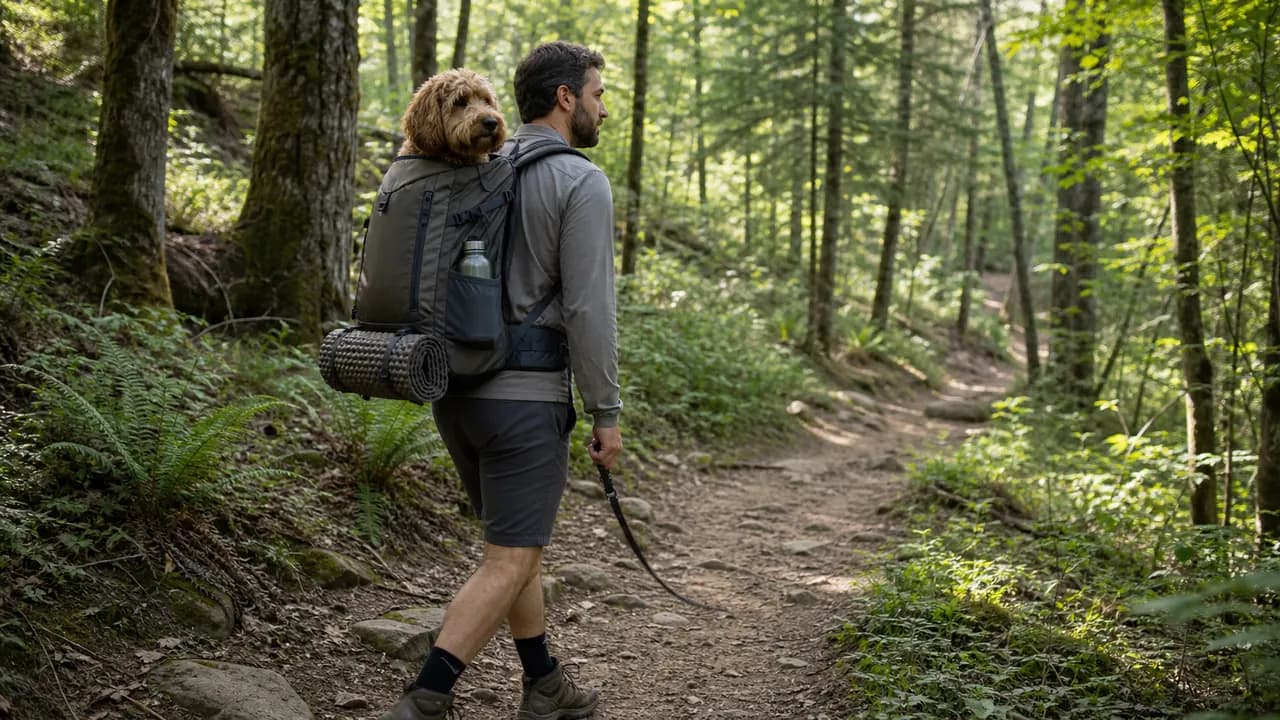
The best dog carrier for hiking is the model whose current maker documentation matches your dog and your route. K9 Air 2, Ruffwear Hitch Hiker, and Tough Traveler Dog Perch use different size systems and carry positions. Ruffwear says the Hitch Hiker accommodates dogs up to 40 lb / 18 kg, with fit and comfort qualifications. Tough Traveler says the Dog Perch carries dogs up to 35 lb. Check the chart, then the individual fit, ventilation, restraints, unloading method, and trail access before buying. This comparison uses maker documentation verified on 2026-09-17. It is not hands-on testing.
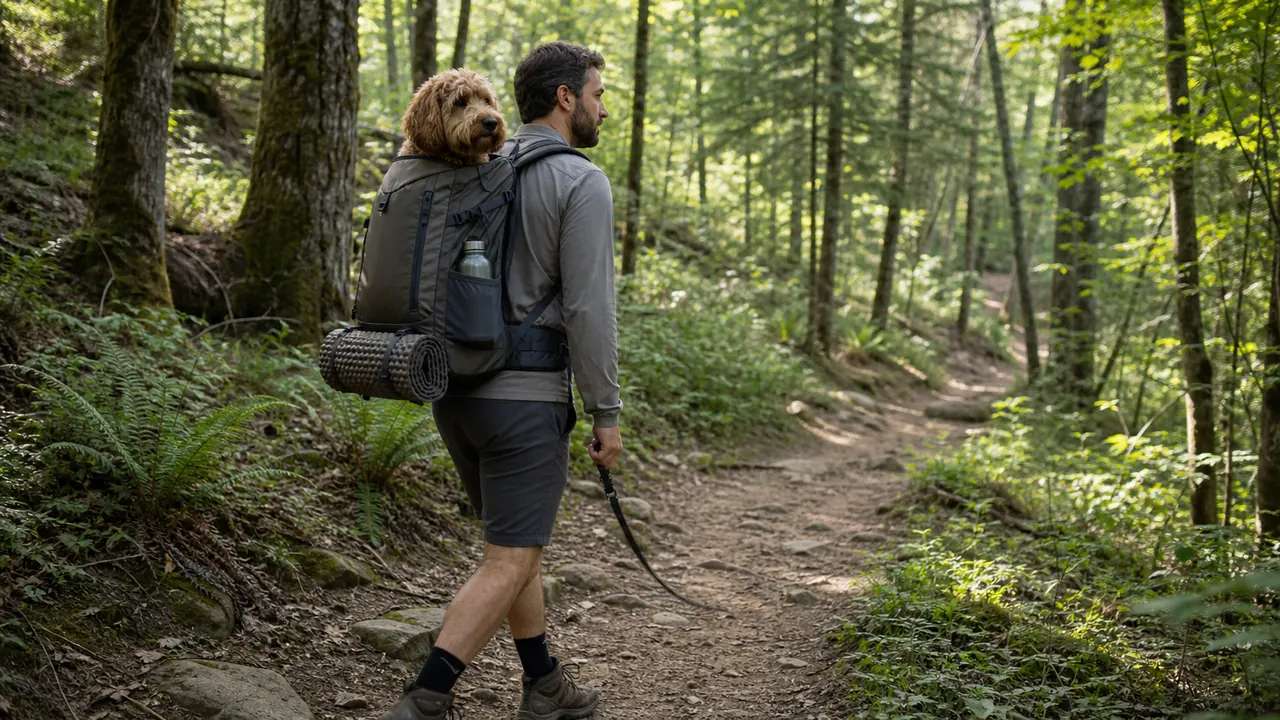
How do the three hiking carriers compare?
The three models solve the same broad problem in different ways, so their size labels cannot be compared directly. Each row below stays within the exact maker page. "Not published" means the page does not give that detail, not that the feature or limit does not exist.
| Model | Intended use | Maker size inputs | Published dog-weight guidance | Carry position | Hiking-relevant features | Main drawback in the documentation | Checked |
|---|---|---|---|---|---|---|---|
| K9 Sport Sack Air 2 | Intermediate walks, hikes, public transport, and bike rides | Collar-to-tail length: X-Small 9-12 in with booster block; Small 13-16 in; Medium 17-19 in; Large 20-22 in | Not published on the exact model page | Backpack on the person; the dog's facing direction is not stated | Ventilated side panels, form-fitting side mesh, wide base, support straps around the dog, adjustable collar enclosure, and one side pocket | No exact-model load limit or complete loading and restraint sequence appears on the page | Verified 2026-09-17 |
| Ruffwear Hitch Hiker | Occasional assistance when a dog needs a ride during an outing | Dog's girth around the widest rib-cage point; back length helps when between sizes; human hip belt fits 21-58 in / 53-149 cm | Accommodates dogs up to 40 lb / 18 kg; Ruffwear says this is about sizing and comfort rather than a structural limit | Dog rides vertically on the person's back, facing forward in the direction of travel | Dual locking zippers, integrated adjustable harness, cinch straps, air-mesh side panels, adjustable torso length, padded shoulder straps, hip belt, pockets, and reflective trim | The guidance requires individual sizing and comfort checks, and the dog rides vertically | Verified 2026-09-17 |
| Tough Traveler Dog Perch | Technical hiking backpack for carrying a dog | Choose a named version by its weight ceiling; the page also calls Mustang and Stallion larger-body sizes but gives no body measurement method | Carries dogs up to 35 lb across seven versions: Double-Decker, Colt, Montana, Palmino, Filly / Kid Carrier, Stallion, and Mustang | Dog sits on the person's back on a flat foam bottom, with front paws able to rest on scooped sides | Internal frame, flat supportive bottom, load-control straps, sternum straps, and a suspension system for the person carrying the dog | The page gives version weight ceilings but no dog measurement method, ventilation feature, or dog-restraint procedure | Verified 2026-09-17 |
The table does not rank comfort or durability. The documentation cannot show how a particular dog responds in a carrier or how the carrier feels on your body.
Which size ranges match small, medium, large, 30 lb, and 20 kg searches?
Treat every size name as brand-specific. A K9 Medium is a 17-19 inch collar-to-tail variant. Ruffwear's XXS, XS, and S start with girth. Tough Traveler uses named versions with weight ceilings. None of those labels can stand in for another brand's chart.
Only these mappings are explicit on the three product pages:
- K9 Air 2 publishes X-Small at 9-12 inches with a booster block, Small at 13-16 inches, Medium at 17-19 inches, and Large at 20-22 inches, all measured collar to tail (K9 Air 2, verified 2026-09-17). Its page does not publish an exact-model load limit.
- Ruffwear offers XXS, XS, and S based primarily on girth. It uses back length to decide whether to size up or down when a dog falls between sizes. The Hitch Hiker accommodates dogs up to 40 lb / 18 kg (Ruffwear Hitch Hiker, verified 2026-09-17).
- Tough Traveler displays Double-Decker up to 8 lb, Colt up to 10 lb, Montana up to 15 lb, Palmino up to 20 lb, Filly / Kid Carrier up to 25 lb, Stallion up to 30 lb, and Mustang up to 35 lb (Tough Traveler Dog Perch, verified 2026-09-17).
A 30 lb search maps to the stated ceiling of the Dog Perch Stallion and falls below Ruffwear's dog-weight guidance of 40 lb / 18 kg. Neither figure establishes fit. Ruffwear says its figure concerns sizing and comfort rather than a structural limit and still requires girth. Tough Traveler's page does not publish a body measurement method. None of these pages documents a carrier for a 20 kg dog. Tough Traveler's highest displayed ceiling is 35 lb, and K9 does not state an Air 2 dog-weight figure.
"Front-facing" also needs care. Ruffwear says the dog faces forward while riding on the person's back. That is not a front-worn chest carrier. The K9 and Tough Traveler pages do not state the dog's facing direction. For a different trip format, compare the travel carrier guide. Keep bike-carrier selection separate because a hiking backpack does not establish bike compatibility.
What safety details are documented for these carriers?
A size-chart match is the first screen, not the whole fit decision. The pages differ sharply in the safety detail they publish, so follow only the instructions for the exact model.
Fit after chart selection
Ruffwear says that Hitch Hiker sizing is based mainly on girth and uses back length when the dog is between sizes. During breaks, Ruffwear tells the user to remove the dog completely, readjust the carrier, and check for pressure points or discomfort (Ruffwear Hitch Hiker, verified 2026-09-17).
The K9 Air 2 page publishes collar-to-tail variants. The Tough Traveler page publishes weight ceilings and identifies two larger-body versions. Neither page gives a post-chart fit-check procedure. A chart match for either model therefore leaves an individual fit question that the product page does not answer.
Ventilation and breathing space
K9 describes ventilated side panels and form-fitting side mesh for breathability on the Air 2 (K9 Air 2, verified 2026-09-17). Ruffwear describes air-mesh panels at the base for airflow and temperature management on the Hitch Hiker (Ruffwear Hitch Hiker, verified 2026-09-17). Neither statement replaces observing the individual dog. The Tough Traveler page does not publish a ventilation feature, so there is no documented airflow claim to compare for that model.
None of the three pages gives a separate test for unobstructed breathing. Do not treat mesh alone as proof that breathing will remain unobstructed for an individual dog.
Closures, attachments, and restraints
Ruffwear gives the most complete restraint description. The Hitch Hiker has dual locking zippers for loading and unloading. Once the dog is inside, Ruffwear says the integrated adjustable harness secures the dog and the cinch straps add security while holding the dog close to the user's back (Ruffwear Hitch Hiker, verified 2026-09-17). The external grab handle is for lifting and shouldering the loaded pack.
K9 lists support straps that encompass the dog and an adjustable collar enclosure on the Air 2. Its page does not state a complete loading, closure, or attachment sequence (K9 Air 2, verified 2026-09-17). Tough Traveler describes the frame, load-control straps, and sternum straps that fit the backpack to the person, but the page does not publish dog-restraint steps (Tough Traveler Dog Perch, verified 2026-09-17).
How should you plan breaks, observation, and an exit?
Ruffwear publishes model-specific observation and break guidance; the other two product pages do not. Ruffwear tells Hitch Hiker users to stay in tune with the dog's signals throughout the carry. It gives a general break guideline of every 30-45 minutes, especially on longer outings. Restlessness, whining, or frequent repositioning may indicate that the dog needs a break. If one of those signals appears, stop and remove the dog completely. Ruffwear says that unloading lets the dog move, drink, and relieve itself and lets the user check for pressure points or discomfort. It advises more frequent breaks in warmer temperatures so the dog can stretch and hydrate (Ruffwear Hitch Hiker, verified 2026-09-17).
That 30-45 minute guidance belongs to the Hitch Hiker page. It is not a universal carrier timetable. The K9 Air 2 and Tough Traveler pages do not publish break, heat, or unloading intervals.
Ruffwear recommends starting Hitch Hiker use with short 15-30 minute sessions and increasing the duration as the dog becomes more comfortable (Ruffwear Hitch Hiker, verified 2026-09-17). That is model-specific guidance, not a universal acclimation schedule or a promise that every dog will accept a carrier.
Use a route exit plan as editorial trip planning, not medical advice:
- Mark places where you can stop and unload without blocking the route.
- Choose a turnaround point and a route back to transport or assistance.
- Keep the exact model's loading and unloading directions available.
- Check the destination's pet rule before departure. The National Park Service says that rules differ by park and directs visitors to each park's website for park-specific information (NPS, checked 2026-09-17).
This route plan does not diagnose distress or define when a dog is medically fit to continue. Ruffwear recommends asking a veterinarian about a dog's health conditions or whether a backpack carrier suits that dog's needs. Seek individual veterinary advice for health or mobility questions rather than using a product label as clearance (Ruffwear Hitch Hiker, verified 2026-09-17).
If the carrier shares the day's packing plan with food and water, organize those items separately with the travel dog food container guide. Do not infer extra carrier capacity from an available pocket.
What should make you reject a carrier?
Reject a model when one required fact fails or remains undocumented. Use one short checklist:
- The maker's stated use does not match the planned carry.
- A required measurement is missing or outside the exact model's published range.
- The dog's weight exceeds an explicit limit.
- The product page does not document a closure, restraint, ventilation, or unloading detail that you need to make the plan workable.
- The individual fit check shows pressure points or discomfort.
- The destination page excludes pets from the route. NPS says park rules vary, so check the specific park page (NPS, checked 2026-09-17).
Do not replace a missing safety detail with a feature claim. Pockets, padding, or a hiking label cannot establish fit, restraint, airflow, or access.
What is the best way to carry a dog on a hike?
Use a format whose maker documents the intended use, size method, position, and restraints you need. A dog carrier transports the dog. A dog-worn pack carries gear instead. The three products compared here are backpacks worn by the person.
What is the best dog carrier for hiking?
There is no universal winner in this documentation comparison. The Hitch Hiker has the fullest published restraint, ventilation, break, and dog-weight guidance. Air 2 has explicit collar-to-tail variants but no exact-model dog-weight figure. Dog Perch offers a seated position and version-specific ceilings but no dog measurement or restraint procedure on its product page.
Do dogs like being carried in backpacks?
The maker pages do not establish a preference for dogs as a group. Ruffwear tells Hitch Hiker users to watch the individual dog for restlessness, whining, or frequent repositioning and to unload the dog completely during breaks (Ruffwear Hitch Hiker, verified 2026-09-17).
How long can you leave a dog in a carrier?
There is no universal duration in these pages. Ruffwear gives Hitch Hiker users a general guideline of a break every 30-45 minutes, with more frequent breaks in warmer temperatures. It also says that individual dogs may need different intervals (Ruffwear Hitch Hiker, verified 2026-09-17).
For broader destination planning, use the pet travel hub. Carrier fit and trail access remain separate decisions from insurance.
Written by the FG Team, the Furry Guardian editorial team, who keeps these border rules current.
- National Park Service, Pets: https://www.nps.gov/subjects/pets/visit.htm
- K9 Sport Sack, Air 2: https://k9sportsack.com/products/air-2
- Ruffwear, Hitch Hiker Dog Backpack Carrier: https://ruffwear.com/products/hitch-hiker-backpack
- Tough Traveler, Dog Perch Backpack: https://toughtraveler.com/products/dog-perch-backpack-regular-medium-large-xl-small-xs