Dog Carrier for Bike: Match Dog, Bike and Route
Choose a dog carrier for a bike by matching your dog, bicycle, route, fit limits, attachment instructions and restraint method.
When an article contains affiliate links, we may earn a small commission at no extra cost to you. It never changes which products we recommend, and plain links to manufacturers earn us nothing.
Dog Carrier for Bike: Match Dog, Bike and Route
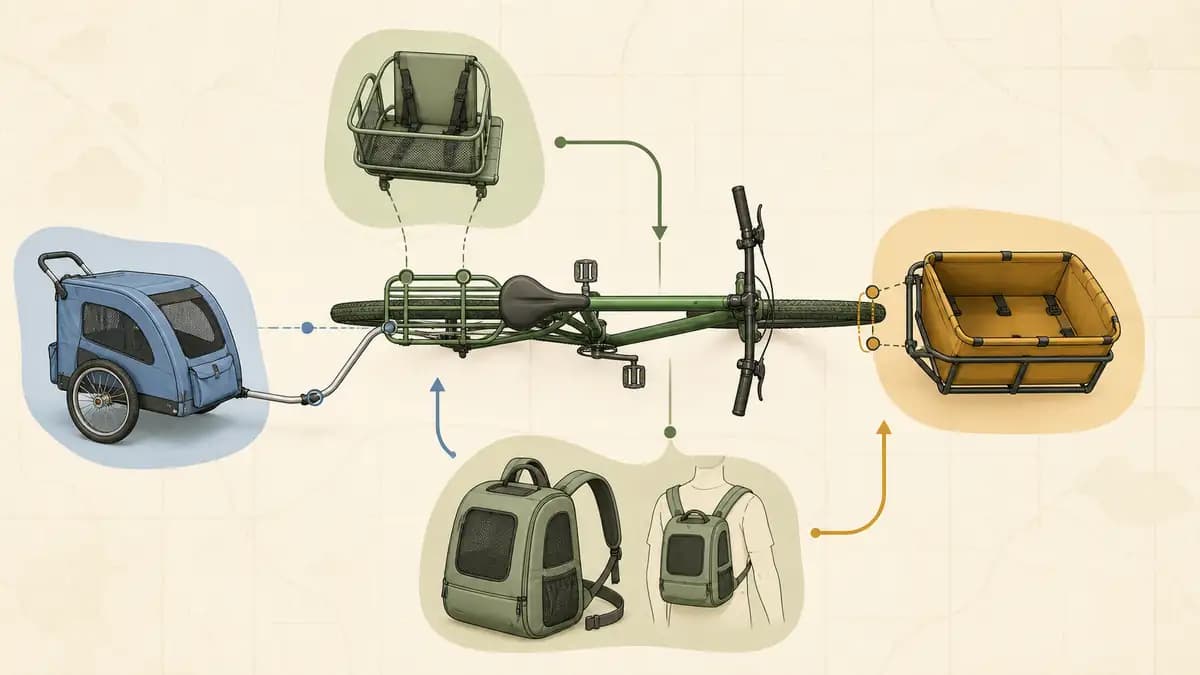
A dog carrier for bike travel should be chosen only after you match three things: your dog, your bicycle and your planned route. Bike carriers include seats or baskets, trailers, cargo conversions and backpacks. Each product has its own fit, load, attachment and restraint instructions. There is no category-level answer that replaces those instructions. Check that both the carrier manufacturer and the bike manufacturer allow the proposed setup, then stay within every stated limit. Consider your dog's condition and ask a veterinarian about individual health questions. If compatibility is unclear, do not ride with the setup. Use only the restraint method stated by the carrier manufacturer, and make any acclimation low-stakes. This guide helps you narrow the category. It does not rank products or declare one category the safest.
What is the safest way to carry a dog on a bike?
There is no supported basis here for naming one universal safest method. The responsible choice is the product-specific setup that matches your dog, bicycle and route while meeting the carrier and bike manufacturers' compatibility rules, stated load limits, attachment instructions and restraint instructions.
For example, The Dog Outdoors says the BuddyRider has a built-in harness intended to prevent a dog from jumping out. That statement applies to that product. It does not establish that every bike seat includes the same feature or that the category is safer than another category. The Dog Outdoors
Safety callout: If either manufacturer does not confirm the proposed combination, treat the setup as unresolved and do not use it for a ride.
A familiar category name is not evidence that a particular carrier fits a particular bike or dog. Product instructions are the deciding reference. If your dog has an individual health issue, ask a veterinarian whether riding is appropriate. The veterinarian can address the dog's condition, while the product and bike manufacturers remain the sources for compatibility and limits.
Can I carry my dog on my bike?
Possibly, but only if the carrier manufacturer and the bicycle manufacturer allow the complete setup and your dog falls within the product's stated fit and load limits. You also need to be able to follow the attachment and restraint instructions as written. This article cannot confirm a setup without the exact carrier and bike documentation.
Before treating a carrier as an option, check:
- Dog match: Compare your dog's measurements and condition with the carrier manufacturer's stated fit and load limits. Ask a veterinarian about individual health questions.
- Bike match: Confirm that the bicycle manufacturer allows the carrier type and that the carrier maker lists the required compatibility.
- Attachment: Follow the carrier manufacturer's attachment instructions without substitutions that the manufacturer has not approved.
- Restraint: Use the restraint method specified for that exact product. A feature described for one product should not be assumed on another. The Dog Outdoors
- Route match: Compare the planned route with every applicable instruction and limit from the carrier and bike manufacturers.
Safety callout: A missing manual, unclear limit or uncertain fit is a reason to pause. Contact the relevant manufacturer instead of filling the gap with a general rule.
Expats should repeat these checks after changing bikes or carriers. Do not assume a setup transfers between bicycles. For other pet movement planning, see Furry Guardian's pet travel guidance. If you need a non-bike option for walking routes, read the dog carrier for hiking guide, then check that product's own instructions and limits.
Are there dog carriers for bikes?
Yes. The current search results show seats or baskets, trailers, cargo conversions and backpacks. Motorcycle carriers also appear in the results, but they are outside this bicycle guide. (DataForSEO SERP, fetched 2026-08-05.) The categories describe different formats, not a shared fit standard.
Burley sells Bark Ranger pet trailers in two sizes for dogs described as large and small. This is a product-range statement, not proof of universal fit and not a category-wide safety claim. Burley
AddBike describes a carrier kit that converts an existing bicycle into a cargo bike by replacing a wheel. The guide does not support an assumption that the conversion fits every bicycle. Compatibility must come from the conversion maker and the bike manufacturer. AddBike
HeyBike's vendor guide describes a dog backpack as designed to hold small dogs. That wording is vendor guidance, not independent testing, and it does not create a universal size limit for backpacks. Check the exact backpack instructions and the bike manufacturer's guidance before considering it. HeyBike
What should I check before the first ride?
Start with the documents for the exact carrier and exact bicycle. Do not let a quiz result, category description or retailer snippet override the manufacturers' instructions. Confirm compatibility and every stated limit before adopting the setup.
Do not proceed when:
- The carrier's fit or load limit has not been checked against your dog.
- The carrier maker does not confirm how the product attaches to your bicycle.
- The bike manufacturer's guidance does not confirm that the proposed setup is allowed.
- The required restraint instructions are missing, unclear or cannot be followed.
- Your dog's condition raises an individual health question that should be taken to a veterinarian.
- The route has not been checked against the product and bike manufacturers' instructions and limits.
Safety callout: Hard uncertainty is a stop signal. Resolve it with the carrier maker, bicycle maker or, for an individual health question, a veterinarian before the first ride.
Once the documentation checks are complete, use a low-stakes acclimation process that stays within the product maker's instructions. The factual ceiling in the available guidance does not support a universal acclimation sequence or duration, so follow the product's directions rather than a generic timetable.
The same documentation habit matters across travel gear. For example, a crate needs its own evidence and instructions rather than assumptions borrowed from a bike carrier. See the guide to crash-tested dog crates for that separate topic.
How do baskets, seats, trailers and cargo conversions differ?
The useful difference is how each format carries or attaches, followed by the product-specific constraints you must verify. A category can narrow your search, but only an exact product manual can support a compatibility decision.
| Category | What the available source supports | What you still must verify |
|---|---|---|
| Seat or basket | One named seat, BuddyRider, is described with a built-in harness intended to prevent a dog jumping out. This cannot be generalized to other seats or baskets. The Dog Outdoors | Exact dog fit, stated load limit, bike compatibility, attachment and restraint instructions from both manufacturers. |
| Trailer | Bark Ranger pet trailers are sold in two sizes described for large and small dogs. That does not establish universal fit. Burley | Exact size and load match, bike compatibility, attachment and restraint instructions from both manufacturers. |
| Cargo conversion | AddBike describes a kit that can replace a wheel to convert an existing bicycle into a cargo bike. The source does not establish compatibility with every bicycle. AddBike | Conversion compatibility, stated limits, installation, dog restraint and all instructions from the conversion and bike manufacturers. |
| Backpack | A HeyBike vendor guide describes a dog backpack as designed to hold small dogs. It is not independent product testing. HeyBike | Exact dog fit, stated load limit, bicycle guidance and the backpack maker's use and restraint instructions. |
This comparison is intentionally category-level. It does not rank products, certify a setup or name a safest carrier. When a product-specific claim appears, keep it attached to that product.
If the carrier and bicycle documents leave the combination uncertain, pause the choice and contact the relevant manufacturers. A category match cannot resolve an unanswered compatibility question or replace a stated product limit.
A practical decision for an international move
A move can change the bike, the carrier, the routes available to you or all three. Treat the setup in the destination as a fresh compatibility question. Keep the exact model documentation accessible and ask the manufacturers when their instructions do not settle the proposed combination.
Insurance is a separate decision from choosing a carrier. If you are reviewing cover for life abroad with a pet, Compare expat pet insurance. Policy research does not replace the carrier manufacturer's limits, the bicycle manufacturer's compatibility guidance or a veterinarian's advice on an individual health question.
Written by the FG Team, the Furry Guardian editorial team, who keeps these border rules current.
- The Dog Outdoors, BuddyRider: https://www.thedogoutdoors.com/collections/favorite-option-for-biking-smaller-dogs
- Burley, pet bike trailers: https://burley.com/collections/pet-bike-trailers
- AddBike, dog carrier guide: https://add-bike.com/en/blog/bike-dog-carrier-the-ultimate-guide-for-cycling-with-large-dogs/
- HeyBike, dog carrier guide: https://www.heybike.com/blogs/heybike-blog/dog-carrier-for-bike
- DataForSEO SERP, fetched 2026-08-05