Dog Seat Belt Safety: What the Evidence Actually Shows
How to assess a dog seat belt by its published evidence, exact model, fit, compatibility, and installation instructions before choosing a restraint.
When an article contains affiliate links, we may earn a small commission at no extra cost to you. It never changes which products we recommend, and plain links to manufacturers earn us nothing.
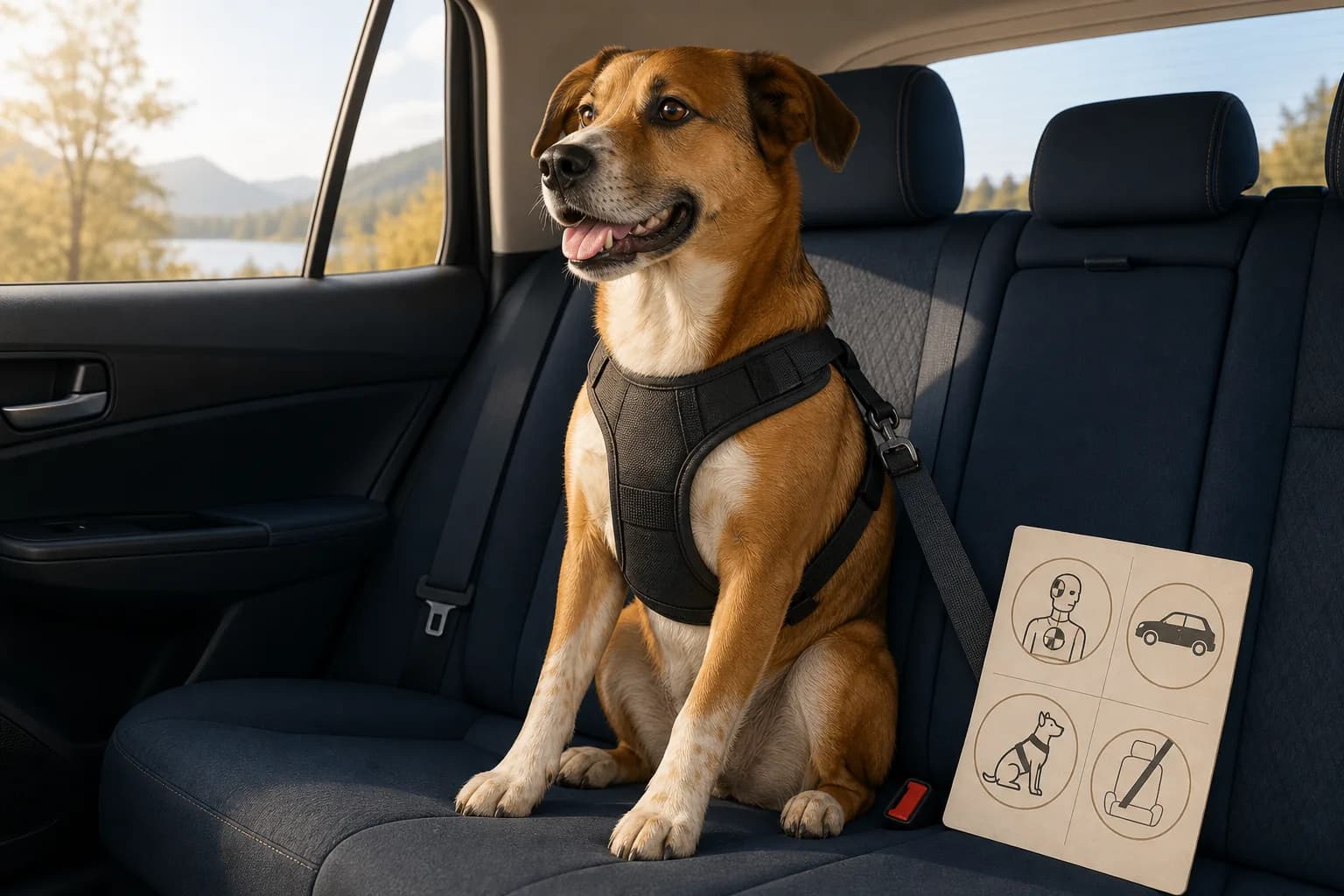
Quick answer: Do not choose a dog seat belt from the label alone; the Center for Pet Safety tells shoppers to look for its Certified logo (Center for Pet Safety). Identify the exact restraint and the evidence published for that model, because CPS says its Certified products meet its independent safety standards (Center for Pet Safety). Confirm fit, vehicle compatibility, and installation on the exact product page (Ruffwear; EzyDog). Ruffwear, for example, tells buyers to measure around the widest part of the rib cage and attach its Load Up harness through the vehicle’s existing seat belt (Ruffwear). Keep each documented claim with the named product and conditions stated by its source (Ruffwear; Sleepypod).
Published: 2026-07-28 Updated: 2026-10-06 By: FG Team
Product and official guidance checked 2026-10-06.
Furry Guardian did not conduct crash tests or hands-on product tests. This guide compares the public evidence linked in each section.
Quick distinction: A buckle tether and a vehicle-belt harness are separate restraint types. Carriers, cages, and guards are also separate types. Highway Code Rule 57 lists a seat belt harness, pet carrier, dog cage, and dog guard as ways to restrain animals in cars (UK Department for Transport).
Are dog seat belts a good idea?
First, identify the product and the evidence for that exact restraint. Only then is “dog seat belt” a useful category. EzyDog describes the Click Zero Shock as a tether. It clips into a vehicle seat belt socket and attaches to a standard EzyDog harness, but not the DRIVE Harness (EzyDog). Ruffwear describes the Load Up as a car harness. It has a loop for the vehicle’s existing seat belt (Ruffwear). Sleepypod describes the Clickit Sport Plus as a harness. It connects to the vehicle belt at three points (Sleepypod).
The same shopping phrase can mean different ways to attach a dog. Each product page makes different claims and gives different fit and installation details (EzyDog; Ruffwear; Sleepypod).
Highway Code Rule 57 says: “When in a vehicle make sure dogs or other animals are suitably restrained so they cannot distract you while you are driving or injure you, or themselves, if you stop quickly” (UK Department for Transport). The rule lists a seat belt harness, pet carrier, dog cage, or dog guard as ways to restrain animals in cars.
For related setups, compare the large-dog car seat evidence guide, back seat cover for dogs guide, crash-tested dog crates guide, and dog barriers for cars.
What is the safest car restraint for dogs?
The available sources do not name one safest restraint for all dogs. Check the evidence for the exact product and size. A “crash-tested” product page may omit the protocol, conditions, tested size, criteria, or result. The Ruffwear Load Up page does not state a test speed, rating, or passing result by size (Ruffwear).
Use this evidence order:
- Confirm the exact product and size named on the page. Sleepypod limits its stated CPS rating for the Clickit Sport Plus to dogs up to 25 lb (Sleepypod).
- Find the stated test details and outcome. Sleepypod states 30 mph testing in accredited labs and a five-star CPS rating, while Ruffwear’s product page gives no test speed or result by size (Sleepypod; Ruffwear). These are maker-published claims.
- Read the stated attachment method. Ruffwear specifies a seat belt loop, Sleepypod describes a three-point vehicle-belt connection, and EzyDog specifies a buckle-and-harness tether connection (Ruffwear; Sleepypod; EzyDog).
- Keep each claim tied to the cited model. The Sleepypod page covers the Clickit Sport Plus. The Ruffwear page covers the Load Up. The EzyDog page covers the Click Zero Shock.
Evidence rule: Do not transfer a maker’s claim or instructions to another model, size, or way of attaching the dog. The cited pages cover specific products and setups (Ruffwear; Sleepypod; EzyDog).
The table below preserves product-page findings checked on October 6, 2026. It is a public-source comparison, not a Furry Guardian test.
| Product page | Restraint type shown | Evidence stated on the page | Limit of that evidence |
|---|---|---|---|
| Ruffwear Load Up | Car harness with a universal seat belt loop that attaches to the vehicle’s existing seat belt (Ruffwear) | Ruffwear describes the Load Up as crash tested, with strength-rated hardware and a universal seat belt loop. Its fitting instructions say to measure around the widest part of the rib cage (Ruffwear). | The checked page does not publish a test speed, a rating, or a pass result by size (Ruffwear). |
| Sleepypod Clickit Sport Plus | Three-point car harness connected to a vehicle seat belt (Sleepypod) | Sleepypod says the Clickit Sport Plus is rated to 25 lb by the Center for Pet Safety, validated at 30 MPH in accredited laboratories, CPS Certified with a five-star rating, built with three points of contact, and connected to a vehicle seat belt (Sleepypod). | The stated rating, validation, certification, contact points, and connection apply to the Clickit Sport Plus described on Sleepypod’s page (Sleepypod). |
| EzyDog Click Zero Shock | Restraint that clips into a vehicle seat-belt socket and attaches to standard EzyDog harnesses except the DRIVE harness (EzyDog) | EzyDog says this restraint clips into a vehicle seat-belt socket and attaches to standard EzyDog harnesses except the DRIVE harness. It is not compatible with Volvo-brand buckles and includes a Zero Shock bungee (EzyDog). | The page does not publish a crash-test protocol or result for the tether (EzyDog). |
| Kurgo Dog Car Restraints | Category page for dog car restraints (Kurgo) | This is a category page for dog car restraints (Kurgo). | Do not attribute a crash-test result or certification to the category or to a product from this page (Kurgo). |
Written by the FG Team, the Furry Guardian editorial team, who keeps these border rules current.
What is the safest car seat belt for dogs?
The cited sources distinguish complete harness systems from buckle-in tethers, but they do not establish one safest option for every dog. Ruffwear and Sleepypod describe harnesses designed to connect to a vehicle belt. EzyDog describes the Click Zero Shock as a tether that connects a compatible harness to a vehicle buckle (Ruffwear; Sleepypod; EzyDog).
A regular vehicle belt can be part of a restraint system. The maker must have designed the harness for that use. Ruffwear says the Load Up attaches through its universal seat belt loop (Ruffwear). Sleepypod says the Clickit Sport Plus uses a three-point design that connects to the vehicle belt (Sleepypod).
A buckle tether works in another way. EzyDog says the Click Zero Shock clips into the vehicle’s seat belt socket. It then clips to a compatible EzyDog harness (EzyDog). EzyDog says the tether does not fit Volvo-brand seat belt buckles. You must not use it with the EzyDog DRIVE Harness (EzyDog).
These maker instructions are product-specific:
- Ruffwear Load Up: Route the existing vehicle belt through the harness’s universal seat belt loop (Ruffwear).
- Sleepypod Clickit Sport Plus: Sleepypod describes a three-point connection and links adjustment instructions and a product manual (Sleepypod).
- EzyDog Click Zero Shock: Clip the tether to a compatible standard EzyDog harness and vehicle buckle, excluding the DRIVE Harness and Volvo-brand buckles (EzyDog).
If a carrier fits the trip, the pet carrier backpack guide covers that separate restraint path. Highway Code Rule 57 lists a pet carrier and a seat belt harness separately (UK Department for Transport).
What does crash-tested mean for a dog seat belt?
A “crash-tested” label does not, by itself, state the test speed, conditions, model, size, pass rules, or result. Read the details on the exact product page and keep maker claims separate from independent evidence.
Read the complete claim: Ruffwear’s Load Up page says “crash tested.” That page does not give a speed or a result by size (Ruffwear). Sleepypod’s Clickit Sport Plus page states 30 mph and accredited labs. It also states a five-star CPS rating and a CPS-rated limit of 25 lb (Sleepypod). EzyDog’s Click Zero Shock page does not publish a crash-test protocol or outcome (EzyDog).
How should a dog seat belt fit and attach?
Use the current size chart and belt path for the exact model. Check its attachment points and accessory limits. Ruffwear tells buyers to measure around the widest part of the rib cage. It gives girth bands for each Load Up size (Ruffwear). Sleepypod links adjustment instructions and a product manual from the Clickit Sport Plus page (Sleepypod). EzyDog names both the compatible harness family and the excluded vehicle buckles for the Click Zero Shock (EzyDog).
Pre-drive evidence checklist
- Match the model and size to the published claim. Sleepypod limits its stated CPS rating for the Clickit Sport Plus to dogs up to 25 lb (Sleepypod).
- Measure at the maker’s stated point. Ruffwear specifies the widest part of the rib cage for the Load Up size chart (Ruffwear).
- Follow the exact belt path. Ruffwear specifies a seat belt loop, while Sleepypod provides its own adjustment instructions and manual (Ruffwear; Sleepypod).
- Use only stated accessory combinations. EzyDog says the Click Zero Shock attaches to standard EzyDog harnesses except the DRIVE Harness (EzyDog).
- Check vehicle compatibility. EzyDog says the Click Zero Shock does not fit Volvo-brand seat belt buckles (EzyDog).
- Check the rule where you will drive. Highway Code Rule 57 provides the Department for Transport wording quoted above (UK Department for Transport).
For the next part of an international trip, browse the pet travel hub. Keep the transport-restraint check separate from the pet insurance comparison.
Which dog belt is best for your setup?
The sources do not name one best dog belt for every setup. Match the model, stated fit, attachment path, and published claim to your setup. The maker pages give fit and attachment methods for each product (Ruffwear; Sleepypod; EzyDog).
Use these decision points:
- Choose the evidence path first: a maker’s detailed test claim, a maker’s crash-tested label with fewer details, or a buckle tether described only as a connection product (Sleepypod; Ruffwear; EzyDog).
- Match the attachment path: a three-point harness connected to the vehicle belt, a harness with its own belt loop, or a tether clipped to a compatible harness and buckle (Sleepypod; Ruffwear; EzyDog).
- Keep every claim within its published scope: exact model, size, test details, fit method, and compatible accessories (Sleepypod; EzyDog).
The shared term “dog seat belt” is not the decision. The evidence for the exact restraint is the decision.
Can you make a homemade dog seat belt?
The official sources checked for this update do not validate a homemade dog seat belt (UK Department for Transport; Center for Pet Safety). UK Highway Code Rule 57 names a seat belt harness, pet carrier, dog cage, or dog guard as examples of suitable restraint, but it does not provide or validate a homemade construction (UK Department for Transport). The Center for Pet Safety says its Certified products meet its independent safety standards and tells shoppers to look for its Certified logo; that statement applies to Certified products, not to an improvised device (Center for Pet Safety).
An improvised restraint cannot inherit a test or certification claim made for a named product (Ruffwear; Sleepypod). Choose a system with evidence published for that exact product and follow the manufacturer’s installation instructions (Center for Pet Safety; Ruffwear). Ruffwear’s crash-tested claim, for example, is made for the Load Up harness and its stated seat belt attachment (Ruffwear); Sleepypod’s stated validation and certification apply to the Clickit Sport Plus described on its page (Sleepypod).
Should dogs sit in the front or back of a car?
The ASPCA advises keeping pets secure in a well-ventilated crate or carrier for car travel, describes a crate as its safest option in case of an accident, and says the crate should be secured so it does not slide or shift. If a crate is not used, the ASPCA says to keep the pet in the back seat in a harness attached to a secured seat belt (ASPCA).
That is ASPCA travel guidance, not a worldwide legal rule. Separately, UK Highway Code Rule 57 says animals should be suitably restrained so they cannot distract the driver or injure the driver, themselves, or others during a quick stop; it lists a seat belt harness, pet carrier, dog cage, or dog guard as examples (UK Department for Transport).
Sources
- Ruffwear, Load Up Dog Car Harness: https://ruffwear.com/products/load-up-dog-car-harness
- Sleepypod, Clickit Sport Plus: https://sleepypod.com/products/sport-bundle
- Kurgo, Dog Car Restraints: https://www.kurgo.com/dog-travel/dog-car-restraints
- EzyDog, Click Zero Shock: https://store.ezydog.com/products/click-zero-shock
- UK Department for Transport, Highway Code Rule 57: https://www.gov.uk/guidance/the-highway-code/rules-about-animals-47-to-58
- Center for Pet Safety, CPS Certified Products: https://www.centerforpetsafety.org/cps-certified/
- ASPCA, Travel Safety Tips: https://www.aspca.org/pet-care/general-pet-care/travel-safety-tips