Best dog barriers for cars & SUVs: Fit Guide
Choose dog barriers for cars and SUVs by cabin layout, measurements and exact vehicle fit. Learn why a barrier is not the same as a crash restraint.
When an article contains affiliate links, we may earn a small commission at no extra cost to you. It never changes which products we recommend, and plain links to manufacturers earn us nothing.
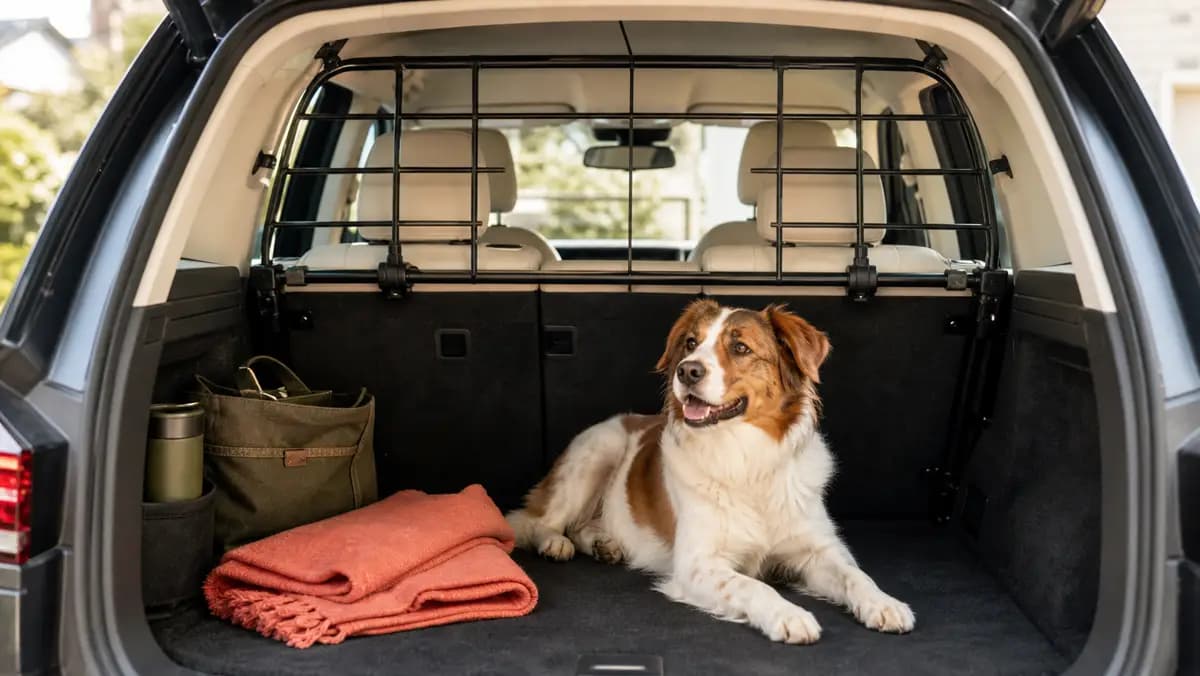
The best dog barriers for cars and SUVs are the ones that separate the intended space, match the exact vehicle and leave no fit question unanswered. Start by deciding whether you need to block the gap behind the front seats, separate an open cargo area from the cabin or divide the cargo area itself. Then measure the vehicle and verify every fit requirement on the current maker page. A barrier is a cabin divider, not automatic evidence of crash protection or a replacement for a separately evaluated restraint.
What are the best dog car barriers for SUVs?
There is no evidence-bound universal winner. For an SUV, the best choice is a barrier format that matches the location of the dog and the exact interior configuration of that vehicle. An open cargo area calls for a different shape and mounting position than the gap between front seats and a rear bench. A divider within the cargo area answers a third, distinct need.
Furry Guardian did not install or crash-test the products discussed in this guide. This is a desk assessment based on the current sources cited below. We compare intended location, fit questions and the scope of available evidence. We do not rank barriers by unverified performance.
Use this quick decision table before looking at brands:
| Your actual need | Barrier format to investigate | What must be confirmed | What the choice does not prove |
|---|---|---|---|
| Keep a dog behind the front row | Back-seat barrier attached around the front-seat area | Headrest setup, door configuration, seat position and coverage of the opening | Crash protection or restraint performance |
| Separate an SUV cargo area from the passenger cabin | Cargo-area guard | Exact make, model, body style, year and mounting position | That another vehicle listing will fit yours |
| Create two zones inside the cargo area | Cargo divider compatible with the surrounding layout | Cargo dimensions, barrier compatibility and usable space on both sides | That the dog is restrained in a collision |
This format-first approach avoids a common category error: choosing a product because it looks substantial without establishing where it fits or what evidence applies to it.
How do you choose the right dog barrier for a car or SUV?
Choose by layout first and product second. A broad label such as “SUV barrier” is not enough because the relevant question is whether the product closes the specific opening in your specific interior.
Follow this order:
- Identify where the dog will ride: rear bench, open cargo area or one zone of the cargo area.
- Define the boundary you need to close: behind the front seats, between cargo and cabin or within the cargo space.
- Record the vehicle details and measurements that control fit.
- Check the current maker page for compatible configurations and explicit exclusions.
- Evaluate any harness, crate, pet seat or carrier separately from the barrier.
If the dog rides on the rear bench, also compare how the barrier shares space with a back-seat cover for dogs. If you are considering a seat-mounted restraint or travel seat instead, use the dog seat belt guide and the guide to a dog car seat for large dogs. Those are different product paths, not interchangeable names for a cabin barrier.
What should you measure before buying a dog car barrier?
Measure the actual installation area rather than relying on the vehicle category in a search result. Seats, headrests and cargo layouts determine the opening a barrier must cover.
Use this vehicle-measurement checklist:
- Measure the width of the opening at the intended mounting position, not at the widest point elsewhere in the cabin.
- Measure the height from the relevant floor or seat surface to the roof area at that same position.
- Note the shape, position and adjustability of the headrests involved in installation.
- Check whether moving or folding a seat changes the opening or the proposed attachment points.
- Record the make, model, body style, year and number of doors exactly as the maker asks for them.
Also inspect what occupies the surrounding space. Confirm that the proposed barrier does not depend on an attachment point you need for another product. Compare the dimensions you recorded with the current product instructions or listing. A visual resemblance between two cabins is not a fit confirmation.
After installation, fit still needs a practical check. Look for uncovered routes around the sides, top and bottom of the divider. Confirm that normal seat positions do not undo the coverage. These checks tell you whether the product divides the intended space. They do not turn a fit check into crash evidence.
What current product example is supported by the available sources?
The Kurgo Backseat Barrier is the only named barrier in this refresh with a current accessible product source. Kurgo says it attaches to the backs of the front seats. The maker describes it as a cloth barrier with a mesh top and integrated horizontal and vertical bars. Kurgo also says it can be installed with fixed or removable headrests and describes it as easy to install and remove. These are maker claims, not independent test results (Kurgo Backseat Barrier, Verified October 13, 2026).
The documented exclusions matter as much as the features. Kurgo says this model does not work with 2-door cars or minivans (Kurgo Backseat Barrier, Verified October 13, 2026). That makes it an example of a barrier for the space behind the front seats, not a universal answer for every car, SUV or cabin layout.
No independent crash-test result for this barrier is established by the allowed sources. Its construction, attachment location and maker-described convenience do not supply that missing evidence.
How is a dog barrier different from a crash restraint?
A barrier separates areas of a vehicle. A crash restraint is evaluated for a different job: managing the animal or travel product during a collision. A barrier may help define where a dog rides during ordinary travel, but separation alone is not proof of crash protection.
The Center for Pet Safety test-results page currently exposes these research filters: “Harness Research,” “Crate Research,” “Pet Seat Research” and “Carrier Research” (Center for Pet Safety). It does not expose a general cabin-barrier research filter. That does not mean CPS has tested or rejected every barrier. It means this page does not provide a general barrier result that can be applied to the category.
Read safety evidence narrowly:
- Match the exact product, model and size to the cited result.
- Keep the result within its listed category, such as harness, crate, pet seat or carrier.
- Do not transfer a result from one product to a barrier, related model or wider product range.
- Review the barrier and any separate restraint as two products with separate evidence records.
If crash evidence is central to your decision, compare the exact items and cited results in our guide to crash-tested dog crates. The word “barrier,” the material used and a close vehicle fit are not substitutes for an exact test result.
Is a mesh barrier or rigid guard better for an SUV?
Neither material wins without reference to the job and fit. A cloth-and-mesh barrier attached behind the front seats addresses a different opening from a guard positioned between an SUV cabin and cargo area. A cargo divider serves another purpose again. Comparing them as if material alone determined the best choice hides the more important layout decision.
Ask these questions instead:
- Does the product belong at the boundary you need to close?
- Does the current listing cover your exact vehicle configuration?
- Do its attachment requirements match the seats, headrests or cargo area in front of you?
- Are its exclusions compatible with your vehicle?
- Is every safety statement tied to an exact product and source?
This evidence-bound comparison may produce a different answer for two vehicles that are both called SUVs. That is expected. The interior boundary and confirmed fit are the decision, not the broad body-style label.
Can you use a dog barrier with a seat belt, travel seat or crate?
Treat each item as a separate product with a separate purpose. A barrier can divide the cabin while another product follows its own attachment and fit requirements. The presence of one does not validate the other, and an evidence record for a harness, crate, pet seat or carrier does not extend to the barrier.
Check whether the products compete for the same seat, headrest, attachment point or cargo space. Then assess the exact restraint or enclosed travel product using evidence for that exact item. Start with the dog seat belt guide, large-dog car seat guide or crash-tested dog crate guide, depending on the category you are actually considering.
Should you build a DIY dog barrier for your car?
This guide has no validated DIY design or test evidence, so we do not recommend a homemade barrier. A home-built divider would still need to answer the same fit questions, and this source set provides no basis for a crash-protection claim.
Use a current maker listing to confirm the intended installation area, compatibility and exclusions for a purchased product. Keep that fit decision separate from the evidence for any restraint or enclosed travel product.
What is the final buying checklist for dog barriers for cars?
Before buying, make sure you can answer all of these questions from the vehicle in front of you and the current maker information:
- Where will the dog ride, and which exact opening needs to be divided?
- What are the width and height at the intended installation position?
- Which seats, headrests, doors or cargo features affect mounting and coverage?
- Does the maker explicitly support the exact make, model, body style, year and configuration?
- Have you kept fit, separation and crash evidence as three different claims?
The best dog car barriers for SUVs are therefore not a fixed ranked list. The defensible choice is the format that matches the right boundary, fits the exact vehicle and makes no unsupported promise about restraint or crash protection.
Written by FG Team, the Furry Guardian editorial team, who keeps these border rules current.
- Center for Pet Safety, Test Results: https://centerforpetsafety.org/test-results/
- Kurgo, Backseat Barrier product detail: https://www.kurgo.com/p/backseat-barrier/K00006