Airline Pet Policies: Check the Route Before Booking
Compare airline pet policies by route, plane, pet rules, carrier fit, and entry papers before you book.
When an article contains affiliate links, we may earn a small commission at no extra cost to you. It never changes which products we recommend, and plain links to manufacturers earn us nothing.
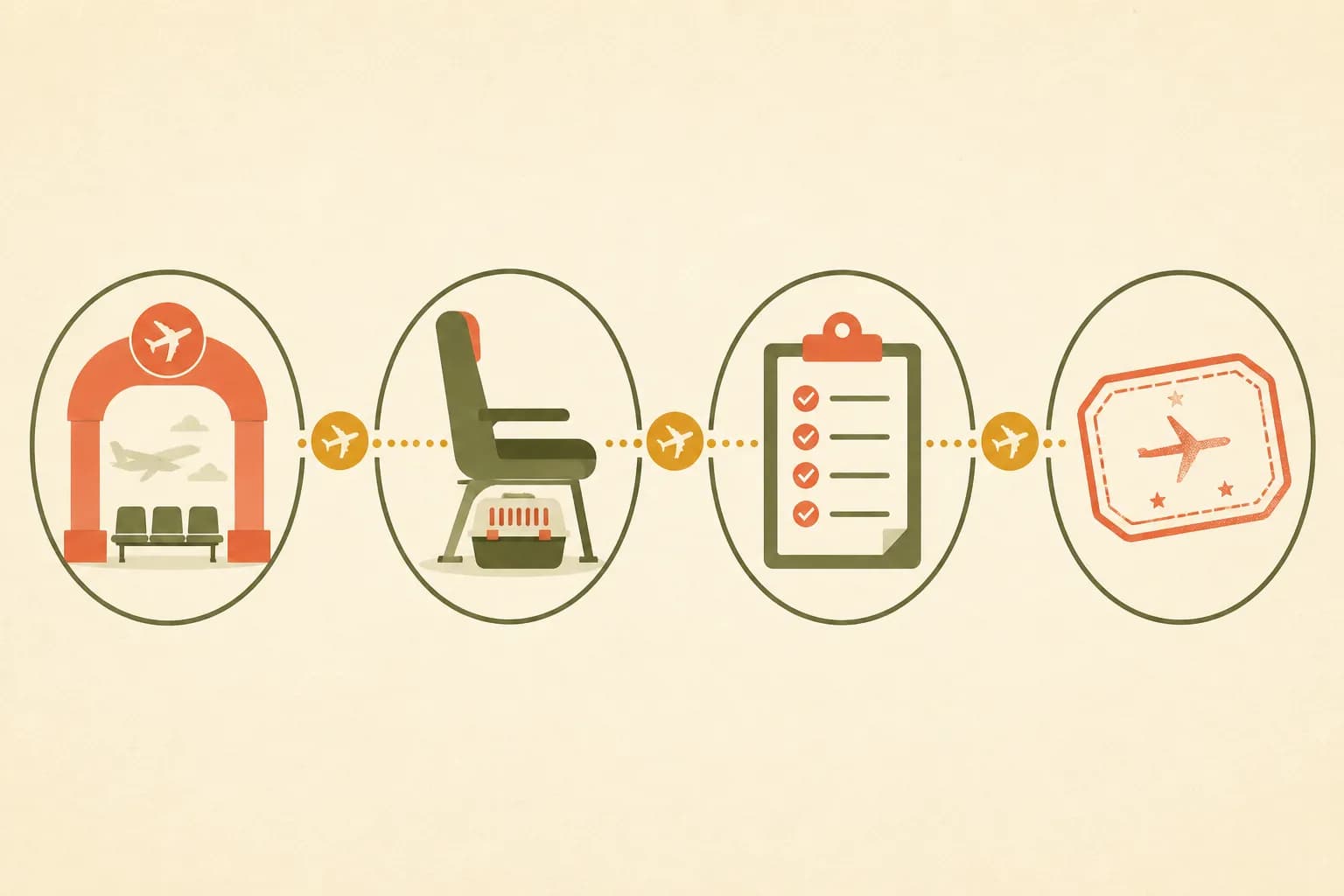
Before paying, check airline pet policies for the exact route, operating airline, flight, aircraft, pet, carrier, and border papers (FAA; IATA). The FAA lets each airline decide whether to accept ordinary cabin pets (FAA). IATA says to confirm acceptance for your day and flight (IATA). Delta says under-seat space varies by aircraft (Delta). Buying another passenger seat is not the FAA or IATA acceptance test, so ask the operating airline to confirm the pet for the exact flight, aircraft, and route (FAA; IATA). APHIS says the destination country sets its pet-entry requirements and travelers must verify them for every trip (USDA APHIS).
Our verdict: compare the real trip, not airline names in a generic ranking.
FAA, IATA, American, and Delta were rechecked successfully on September 29, 2026. USDA APHIS and CDC remain verified September 26, 2026 because September 29 checks returned HTTP 403 without exposing claim text.
What should you check before booking a pet flight?
Use this order to reach a booking decision:
- Identify every operating airline. American says another airline can operate a flight that has an American flight number, and tells passengers to look for "Operated by" on the ticket (American). Delta tells passengers on partner-operated flights to verify that partner's in-cabin animal policy (Delta).
- Confirm the day and flight. IATA says to ask the chosen airline if it accepts the pet on that day and flight because some airlines restrict the number of animals on a flight (IATA).
- Check the pet and route against each operating airline's rules. American limits carry-on pets to cats and dogs that meet its size, age, and destination requirements (American). Delta's domestic cabin path covers small dogs, cats, and household birds that meet its age, health, size, and kennel requirements on flights within the contiguous United States (Delta).
- Check the aircraft before buying a carrier. Delta says its maximum in-cabin kennel dimensions depend on the aircraft because under-seat space varies (Delta).
- Check destination and return-entry papers separately. APHIS says the destination country sets its pet-entry requirements and travelers must verify them for every trip (USDA APHIS). For a dog entering the United States, CDC says the requirements depend on where the dog was vaccinated and which countries it visited during the six months before entry (CDC).
Do not treat a booking request as final approval because IATA says airlines have specific procedures to accept, handle, and deliver animals (IATA). IATA also tells you to confirm approval for the chosen flight (IATA).
Which source decides each part of the trip?
This is a decision table, not a ranking. It shows why one rule cannot answer every airline pet question.
| Decision | Official source to read | What the source says |
|---|---|---|
| Whether a pet may enter the passenger cabin | Airline, with the FAA baseline | The airline decides whether pets may travel in the cabin, and some airlines do not allow cabin pets (FAA). |
| Whether the carrier fits the booked plane | Airline that runs the flight | Delta says its maximum in-cabin kennel dimensions depend on the aircraft because under-seat space varies (Delta). |
| Whether the animal has enough room in the carrier | IATA guidance plus airline rules | IATA says the animal must be able to turn normally while standing, stand and sit erect, and lie in a natural position (IATA). |
| Whether the route accepts a cabin pet | Airline that runs the flight | American lists eligible travel for its carry-on pet path, while Delta gives separate conditions for travel within and outside the contiguous United States (American; Delta). |
| Which papers allow entry | Border authority for the destination and return | APHIS says the destination country sets its pet-entry requirements, while CDC bases U.S. dog-entry requirements on vaccination location and countries visited in the prior six months (USDA APHIS; CDC). |
The FAA page does not publish a universal pet-weight cutoff (FAA). The airline's current policy controls acceptance, and Delta says its maximum in-cabin kennel dimensions depend on the aircraft (FAA; Delta).
How do cabin, checked, and cargo travel differ?
The official pages set different conditions for cabin, hold, and cargo paths (IATA; American):
- Cabin: The airline decides if it accepts pets in the cabin (FAA). If it does, the FAA treats the pet container as carry-on baggage (FAA). It must fit under the seat without blocking a path to the main aisle (FAA).
- Checked or hold travel: IATA says some airlines transport pets as special baggage in a heated and ventilated hold, while American limits ticket-counter checked pets to active-duty U.S. Military and U.S. State Department Foreign Service personnel traveling on official orders (IATA; American).
- Cargo: American directs animals that do not qualify for its carry-on or checked-pet paths to American Airlines Cargo, which has separate restrictions (American).
- Service animal: The FAA states that service animals are not pets and points travelers to the separate U.S. Department of Transportation service-animal rules (FAA).
Read the terms of the airline that runs each segment. American says it does not collect pet fees for other operating airlines even when the flight has an American flight number, and Delta tells passengers on partner-operated flights to verify that partner's policy (American; Delta).
Can a 50-pound dog fly in the cabin?
The FAA page does not publish a universal 50-pound cabin rule (FAA). The FAA lets each airline decide if it accepts a pet in the cabin (FAA). An accepted pet container must fit under the seat without blocking a path to the main aisle (FAA). IATA says only small dogs and cats can go in the cabin (IATA). The carrier must let the animal stand, sit, turn, and lie in a natural position (IATA).
Weight alone does not answer whether a dog qualifies for an ordinary cabin-pet path (FAA; IATA). The FAA requires an accepted container to fit under the seat, while IATA says only small dogs and cats can go in the cabin (FAA; IATA). Our large-dog cabin guide keeps this choice apart from service-animal rules.
Can you buy your pet a seat on a plane?
Buying a passenger seat is not the acceptance test stated on the official ordinary-pet pages checked here (FAA; IATA). The FAA says the airline decides if it accepts cabin pets and treats an accepted pet container as carry-on baggage that must fit under the seat without blocking a path to the main aisle (FAA). American says a carry-on pet must stay in the carrier under the seat for the entire flight (American). Delta says the pet must stay secured inside the kennel in the airport and onboard (Delta).
Ask the operating airline to confirm the pet for the exact flight, aircraft, and route before buying another passenger seat (FAA; IATA).
What carrier size do you need for a cabin pet?
The FAA page does not publish one carrier size for every airline and aircraft (FAA). The FAA says the container must fit under the seat without blocking a path to the main aisle (FAA). Delta says its maximum in-cabin kennel dimensions depend on the aircraft because under-seat space varies (Delta).
IATA says the carrier must let the animal turn normally while standing, stand and sit erect, and lie in a natural position (IATA). Use the air-travel crate fit checklist, then confirm the operating airline's current rule for the exact flight (IATA).
Can you bring a pet and another carry-on?
The pet carrier counts as carry-on baggage under the FAA rule, while the airline controls whether another item is allowed (FAA). American lets a passenger with a pet carrier bring either one personal item or one carry-on bag, but not both (American). Delta lets a passenger with a kennel bring one personal item or one carry-on item (Delta).
Use the rule of the airline that operates the flight. American says another airline may operate a segment with an American flight number, and Delta directs passengers on partner-operated flights to verify that partner's policy (American; Delta).
What documents do you need to bring a pet on a plane?
The FAA says an airline may ask for a recently issued health certificate (FAA). IATA says most airlines ask for a veterinarian-issued health certificate (IATA). IATA says that certificate must state that the animal is healthy and fit to fly (IATA).
For travel outside the contiguous United States, Delta requires the documents needed for the pet to enter the destination and return to the country of origin when applicable, plus Delta's age, health, size, and kennel requirements (Delta). APHIS says the destination country sets its pet-entry requirements and travelers must verify them every time they plan a trip with a pet (USDA APHIS). For a dog entering the United States, CDC directs travelers to its Dog Importation Navigator to determine which requirements apply (CDC). Use our USDA pet travel guide to find the relevant U.S. path. For Portugal-specific planning, see our moving to Portugal with a dog guide.
What airline will allow your pet to fly?
The answer is the operating airline that confirms this pet on this route, day, flight, and aircraft (IATA; American; Delta). The FAA says each airline decides if it allows pets in the cabin (FAA). The FAA says some airlines do not allow cabin pets (FAA). IATA says to ask the airline if it accepts the pet on the day and flight you want (IATA).
American limits carry-on pets to cats and dogs that meet its size, age, and destination requirements, and its page defines eligible travel for that path (American). Delta's domestic cabin path covers small dogs, cats, and household birds that meet its age, health, size, and kennel requirements on flights within the contiguous United States (Delta). Ask the operating airline to confirm the pet on the preferred day and flight because IATA says some airlines restrict the number of animals on a flight (IATA).
For a carrier-specific international example, see our Copa Airlines international pet policy guide.
Written by the FG Team, the Furry Guardian editorial team, who keeps these border rules current.
- FAA, Flying with Pets, verified 2026-09-29: https://www.faa.gov/travelers/fly_pets
- IATA, Traveler's Pet Corner, verified 2026-09-29: https://www.iata.org/en/programs/cargo/live-animals/pets/
- American Airlines, Traveling with pets, verified 2026-09-29: https://www.aa.com/web/i18n/travel-info/special-assistance/pets.html
- Delta, Pet Travel Overview, verified 2026-09-29: https://www.delta.com/us/en/pet-travel/overview
- USDA APHIS, Take a Pet From the United States to Another Country, verified 2026-09-26: https://www.aphis.usda.gov/pet-travel/us-to-another-country-export
- CDC, Bringing a Dog into the U.S., verified 2026-09-26: https://www.cdc.gov/importation/dogs/index.html