Dog Crate for Air Travel: Fit and Inspection Checklist
Choose a dog crate for air travel by transport mode, measured fit, observable construction and confirmation from the operating airline.
When an article contains affiliate links, we may earn a small commission at no extra cost to you. It never changes which products we recommend, and plain links to manufacturers earn us nothing.
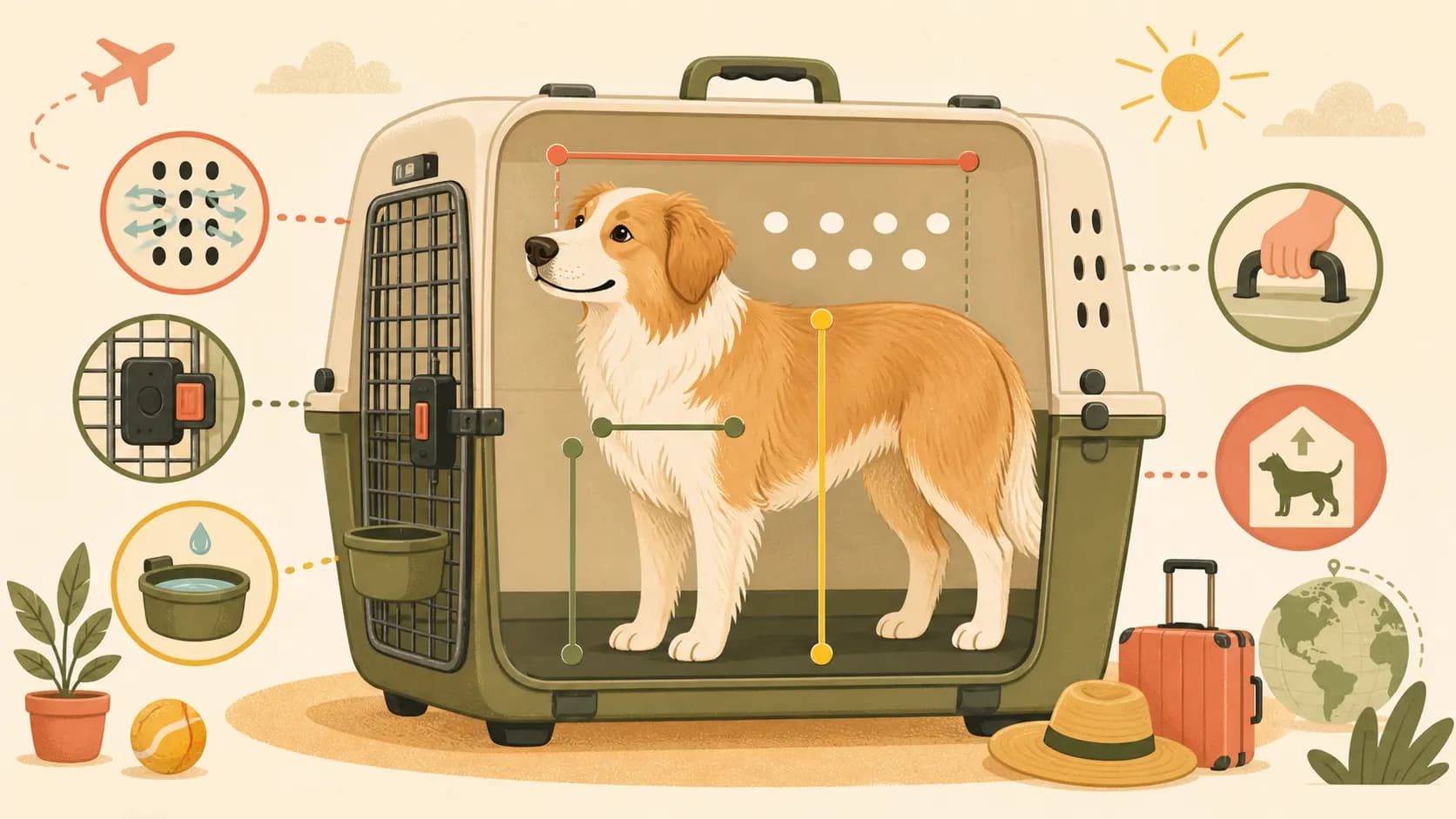
No dog crate for air travel is universally "airline approved." IATA tells travelers to contact the chosen airline to confirm that it will accept the animal on the preferred day and flight (IATA). First decide whether you are asking about cabin travel or hold/cargo transport. Then measure your dog and inspect the product's construction. A suitable container must let the dog turn normally while standing, stand and sit erect, and lie naturally (IATA). Ask the operating airline to confirm the current policy for the exact crate, animal, day and flight (IATA).
Which crate type should you compare first?
Start with the planned mode: cabin, or transport in the hold/cargo. Do not use a hold/cargo construction checklist as a promise that a crate can travel in the cabin, and do not assume a cabin carrier answers the hold/cargo question (IATA). Our guide to flying with a large dog in the cabin keeps that cabin research separate. For either question, contact the operating airline about the animal, day and preferred flight as IATA directs (IATA).
The products below are examples of construction classes to inspect. They are not a ranking, test result or universal recommendation.
| Construction class | Product example | What the manufacturer says | Purchase verdict |
|---|---|---|---|
| Hard-sided plastic | Petmate Sky Kennel, verified 2026-09-19 | Petmate says the product complies with the standards in the 2025 51st edition of the IATA LAR; it lists ventilation at the door, sides and rear; says it meets most airline cargo specifications; and tells buyers always to check with the airline (Petmate). | Inspect the exact size for fit and construction, then seek confirmation from the operating airline for the exact animal, day and flight (IATA). |
| Rotomolded | RuffLand 300 Series Airline Kennel, verified 2026-09-19 | This is the official product name and construction example shown on RuffLand's product page (RuffLand). | Check it against the airline's instructions, the dog's fit and the official checklist. Ask the operating airline to confirm the animal, day and flight (IATA). |
| Aluminum | Impact Airline Dog Crate, verified 2026-09-19 | Impact describes it as "designed to meet airline standards" and lists tie-down points, butterfly latches and holes intended for padlocks (Impact). That wording is not presented here as certification. | Inspect those features, measured fit and the airline's checklist. Ask the operating airline to confirm the exact product, animal, day and flight (IATA). |
How do you measure the dog and estimate internal dimensions?
Measure the dog before selecting a size. IATA defines the measurements this way:
| Mark | Measurement | Record it |
|---|---|---|
| A | Nose tip to tail base or root (IATA) | ______ |
| B | Ground to elbow (IATA) | ______ |
| C | Width across the shoulders or the widest point (IATA) | ______ |
| D | Ground to the top of the head or the highest ear, whichever is higher (IATA) | ______ |
| Bedding | Bedding height used in the internal-height estimate (IATA) | ______ |
Use IATA’s public formulas only as an internal-dimension estimate:
- Approximate internal length:
A + 1/2 B(IATA). - Approximate internal width:
C x 2(IATA). - Approximate internal height:
D + bedding(IATA). - Brachycephalic breeds: IATA indicates a container 10% larger (IATA).
These calculations are an estimate, never evidence of acceptance (IATA). Check the dog in the actual crate. IATA says the container must allow the dog to turn normally while standing, stand and sit erect, and lie in a natural position (IATA). The operating airline decides whether it accepts the animal on that day and flight (IATA).
Which construction points can you inspect yourself?
Use the USDA points as an observable checklist, not as an airline acceptance certificate (USDA).
- Confirm that the kennel is hard-sided and has secure fasteners strong enough for the normal rigors of air transport (USDA).
- Confirm that the door closes securely and opens without a special or sharp tool (USDA).
- Check for sturdy external handles or handholds (USDA).
- Check for ventilation openings on three sides plus the door (USDA).
- Confirm that the materials are non-toxic and not harmful (USDA).
- Confirm that the kennel is clean and sanitized (USDA).
- Check that the floor is leak-proof and has an unused litter pad or collection tray (USDA).
- Check the interior for sharp points or edges (USDA).
- Confirm that the design permits quick and easy emergency removal (USDA).
- Confirm that no part of the dog can protrude from the kennel (USDA).
- Confirm that food and water dishes are attached inside the door and can be reached without opening it (USDA).
How should labels and the document pouch be prepared?
The outside and paperwork are part of the USDA checklist (USDA).
- Put
Live Animallabels in 1-inch letters on the top and on at least one side of the kennel (USDA). - Add upright orientation arrows to show the correct position of the kennel (USDA).
- Attach an accessible document pouch containing owner information, health certificates, routing information and the feeding and watering schedule (USDA).
For the separate document question, use our international health certificate guide for dogs. A document pouch does not by itself answer which certificate applies to a route. IATA directs travelers to check country-specific regulations (IATA).
What should you ask the operating airline?
Keep the request tied to the planned journey. IATA tells travelers to contact the chosen airline and confirm acceptance of the animal on the preferred day and flight (IATA). Ask the operating airline:
- Will this animal travel in the cabin or in the hold/cargo on this flight?
- Will you accept this exact animal on this exact day and flight, as IATA says travelers should confirm with the chosen airline (IATA)?
- Will you accept this exact crate product and size for this animal and flight?
- Which airline checklist should I use for the final review?
An observable pass on fit, shell, door, ventilation, floor, dishes, labels or paperwork is not the airline's answer. IATA directs the traveler to confirm acceptance with the chosen airline (IATA).
What belongs on the final crate checklist?
Use the final checklist to record fit, construction, ventilation, labels, documents and airline confirmation.
- The dog can turn normally while standing, stand and sit erect, and lie naturally (IATA).
- The internal estimate records length as
A + 1/2 B, width asC x 2, and height asD + bedding(IATA). - A brachycephalic dog’s estimate accounts for IATA’s indication of a container 10% larger (IATA).
- The hard shell and secure fasteners are strong enough for the normal rigors of air transport; the door, external handles and non-toxic materials also match the cited USDA inspection points (USDA).
- Ventilation is present on three sides and the door (USDA).
- The kennel is clean and sanitized, and its leak-proof floor has an unused litter pad or collection tray (USDA).
- There are no sharp interior points or edges, no part of the dog can protrude, and the design permits quick and easy emergency removal (USDA).
- Food and water dishes are fixed inside the door and accessible without opening it (USDA).
-
Live Animalappears in 1-inch letters on top and on at least one side, with upright arrows (USDA). - The accessible pouch holds owner information, health certificates, routing information and feeding and watering instructions (USDA).
- The operating airline has confirmed the exact animal, day and flight as IATA directs (IATA).
What is the best dog crate for airline travel?
The best choice passes all three checks for the exact itinerary: measured fit, observable construction and confirmation from the operating airline (IATA). IATA requires room for the dog to turn normally while standing, stand and sit erect, and lie naturally (IATA). No product model is a universal answer because IATA tells the traveler to confirm acceptance with the chosen airline for the preferred day and flight (IATA).
How do you know whether a dog crate is airline approved?
A marketing label alone does not establish acceptance. IATA directs the traveler to confirm acceptance with the chosen airline for the preferred day and flight (IATA). Inspect measured fit and the observable construction points, then ask the operating airline about the exact crate, animal, day and flight.
Can you take your dog’s crate on a plane?
A crate inspection cannot promise cabin or hold/cargo acceptance. IATA tells travelers to confirm the animal's acceptance with the chosen airline for the preferred day and flight (IATA). Ask the operating airline which mode applies and whether it accepts the exact animal and crate.
Can you bring a 70 lb dog on a plane?
IATA's fetched guidance provides no universal 70 lb acceptance rule and instead tells travelers to confirm the animal, day and flight with the chosen airline (IATA). Ask the operating airline about the exact dog, mode and crate.
Where can I buy airline approved dog crates?
You can shop the official product pages for the Petmate Sky Kennel, RuffLand 300 Series Airline Kennel and Impact Airline Dog Crate, but none is universally approved. Petmate says its kennel meets most airline cargo specifications, and both Petmate and Impact tell buyers to check airline requirements (Petmate; Impact). IATA says to confirm acceptance with the chosen airline for the preferred day and flight (IATA).
Can a 25 lb dog fit under an airplane seat?
A 25 lb weight alone does not establish that a dog and carrier can travel under an airplane seat. The fetched IATA guidance gives no universal 25 lb cabin threshold or under-seat dimension (IATA). Ask the operating airline whether it will accept the exact dog and carrier in the cabin on the preferred day and flight, as IATA directs (IATA).
What should you do before buying?
Before buying, choose cabin or hold/cargo as the question, then record A, B, C, D and bedding. Inspect the exact product and request confirmation from the operating airline for the exact animal, day and flight (IATA). Treat manufacturer wording as product information, not as a universal promise. Both Petmate and Impact tell buyers to confirm airline requirements (Petmate; Impact).
Written by the FG Team, the Furry Guardian editorial team, who keeps these border rules current.
- IATA Traveler’s Pet Corner: https://www.iata.org/en/programs/cargo/live-animals/pets/
- USDA APHIS, Preparing and Receiving Pets for Air Travel: https://www.aphis.usda.gov/pet-travel/pets-on-planes/preparing-pets-air-travel
- Petmate Sky Kennel, verified 2026-09-19: https://www.petmate.com/products/petmate-sky-kennel-1
- RuffLand 300 Series Airline Kennel, verified 2026-09-19: https://www.rufflandkennels.com/products/airline-kennels-300-series
- Impact Airline Dog Crate, verified 2026-09-19: https://www.impactdogcrates.com/products/airline-dog-crate